Learn MoreShow Less
Disrupted Sleep
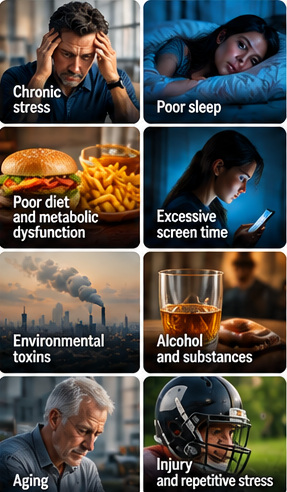
Insufficient or fragmented sleep can impair attention, memory formation, and emotional regulation.
Sleep supports processes involved in learning and the adjustment of connections between neurons. Repeated disruption can affect daytime performance without necessarily indicating permanent injury.
Persistent Stress
Prolonged stress can alter the networks involved in attention, memory, and emotional responses.
Short-term stress can sharpen responses to an immediate demand. When activation persists, attention may become biased toward threats, while flexible thinking and memory retrieval become more difficult.
Head Injury
An impact or rapid acceleration of the head can disrupt brain function and injure neural tissue.
Concussion can affect signaling even when routine imaging shows no obvious structural damage. Effects vary with the injury, and repeated injuries can complicate recovery.
Impaired Blood Flow or Oxygen Delivery
Brain tissue depends on continuous oxygen and nutrient delivery to sustain electrical signaling.
A substantial interruption can quickly impair function and damage cells. Vascular disease can also affect smaller vessels over time, influencing the networks they supply.
Infection and Excessive Immune Activity
Infection or misdirected immune responses can damage neurons, supporting cells, or insulating myelin.
Immune activity normally helps protect nervous tissue. In certain conditions, the response itself contributes to injury and interferes with communication between nerve cells.
Harmful Exposures and Medication Effects
Alcohol, certain toxic substances, and some medications can alter alertness, coordination, or nerve function.
Effects depend on the substance, amount, duration, and individual circumstances. Some are temporary changes in signaling; others involve tissue damage. Medication-related concerns require clinical review.
Metabolic and Nutritional Disturbances
Severe glucose disturbances or deficiencies such as vitamin B12 deficiency can impair nervous-system function.
Neurons depend on a stable chemical environment and adequate nutritional support. Different disturbances affect different processes, from immediate signaling to the maintenance of myelin.
Changes in memory, sensation, balance, or behavior can have many causes; the pattern and timing help guide clinical evaluation.